Master Double Bass: Precision Timing with Free Online Metronome
For many drummers, the double bass pedal represents the ultimate challenge in speed and coordination. Have you ever felt that your feet just cannot keep up with your hands during a fast metal track? You are not alone. Inconsistent double bass drumming is a common hurdle that limits even the most seasoned performers. Whether you are struggling with the precision of your blast beats or you find that your endurance fades after just thirty seconds, the solution often lies in your practice habits.
To bridge the gap between where you are and where you want to be, you need a structured approach. Using a reliable online metronome is the most effective way to build the "internal clock" required for high-speed drumming. Without a steady click, your brain cannot accurately identify where your timing is slipping. By using our online metronome, you can start measuring your progress with mathematical precision.
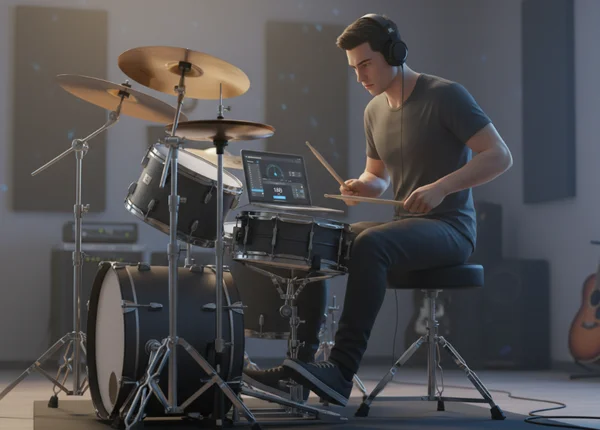
This guide will walk you through the science of drumming mechanics and provide a step-by-step training system. We will explore how to use specific metronome features to master the double bass. Let's dive into the technical and physical aspects of becoming a faster, more accurate drummer.
The Science Behind Double Bass Drum Precision
Precision in double bass drumming is not just about moving your feet quickly. It is a complex interaction between your physical body and your nervous system. To master this, you must understand how your muscles and brain work together to create a steady rhythm. Many drummers focus only on speed, but without the science of precision, that speed will always sound "muddy" or "sloppy."
Foot Mechanics and Muscle Memory Development
The first step to precision is understanding foot mechanics. Whether you use the heel-up or heel-down technique, your legs act like pendulums. For your feet to strike the drum head at the exact same time intervals, the range of motion must be identical for both legs. Your dominant foot naturally leads—but precision demands equality. Balance both feet by isolating weaker strokes.
Training with a free tool allows you to isolate these movements. Muscle memory is developed through thousands of perfect repetitions. If you practice inconsistently, you are essentially "hard-wiring" mistakes into your brain. By keeping the tempo slow and steady, you allow your muscles to learn the exact path of motion required for a clean stroke.
Neurological Pathways for Perfect Timing
Perfect timing is as much a mental skill as it is a physical one. When you play along with a click, your brain develops stronger neurological pathways. This process, often called "entrainment," is when your internal body rhythms sync with an external pulse. Over time, your brain becomes better at predicting when the next beat will occur.
This prediction is what creates "the pocket." For double bass players, this means your feet begin to move automatically. Use a BPM counter to track your timing accuracy across speeds. Notice where your feet waver—this pinpoint precision separates pros from amateurs. Eventually, the metronome stops being an annoying "beep" and starts feeling like a guide that keeps your neurological signals in perfect sync.
Setting Up Your Free Online Metronome for Double Bass Success
Before you start your practice session, you must set up your tools correctly. A metronome is only helpful if you use it in a way that targets your specific weaknesses. Our platform offers several professional-grade features that are perfect for drummers who need more than just a simple click.
Optimal BPM Starting Points for Different Skill Levels
A common mistake is starting at a tempo that is too fast. If you cannot play a pattern perfectly for two minutes, the tempo is too high. Here is a general guideline for starting points:
- Beginners: Start between 60 and 80 BPM. Focus on making every stroke sound identical in volume and tone.
- Intermediate Players: Start between 90 and 110 BPM. This is the range where many drummers begin to feel "tension" in their ankles.
- Advanced Players: Start at 120 BPM and above. Use this to refine your blast beats and high-speed endurance.
You can easily adjust these speeds on our adjustable BPM metronome to find your specific "threshold"—the speed just below where your technique begins to break down.
Utilizing Subdivisions for Maximum Precision
Standard quarter-note clicks are often not enough for double bass practice. When you are playing 16th notes or triplets, the space between the beats is where the errors happen. This is where subdivisions become essential. By setting your metronome to click on every 8th or 16th note, you provide your feet with more "checkpoints" to hit.
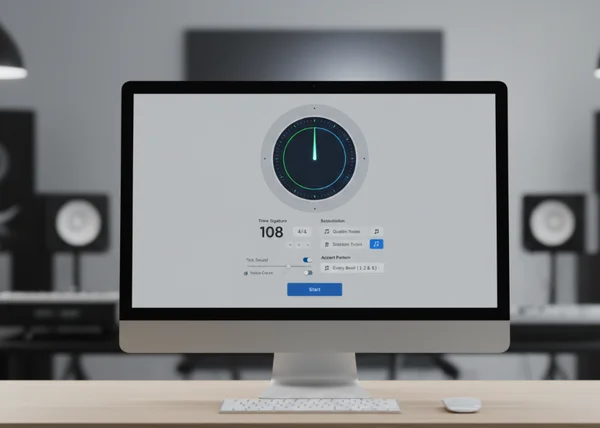
Using this rhythm tool to enable subdivisions helps you hear exactly where a foot is dragging or rushing. If your left foot is slightly late, the subdivision click will expose that gap immediately. This high-resolution feedback is the secret to the machine-gun precision found in professional metal drumming.
Accent Patterns That Build Power and Control
Control is the ability to change the volume of your strokes without losing the tempo. Most double bass drumming sounds better when the first beat of every bar is slightly emphasized. You can set our metronome to provide a "heavy" beat on the one. This helps you keep track of where you are in the measure, especially during long, repetitive sections.
Practicing accents also builds leg strength. It requires a different muscle engagement to hit a "loud" note versus a "soft" note. By alternating accents between your right and left foot, you ensure that both legs are capable of leading the rhythm with equal power.
The Progressive Double Bass Training System
To see real results, you need a plan. Walking into the practice room and just "jamming" will not yield the same results as a structured system. Use the following three-step approach with your metronome to see measurable gains in your foot speed and accuracy.
Foundation Building: 16th Note Patterns at Moderate Tempos
Start your session with 10 minutes of straight 16th notes. Choose a tempo that feels "easy"—perhaps 80 BPM. Your goal here is not speed; it is consistency. Listen closely to the "flam" or the gap between your feet. There should be none.
Use this time to check your posture. Are your shoulders relaxed? Are you breathing? If you find yourself tensing up, slow the metronome down by 5 BPM. Focus on the "click" and let your feet fall into the rhythm naturally. This foundation ensures that when you do go fast, your technique is built on a solid, relaxed base.
Speed & Endurance Development Strategies
Blast Beat Pyramid Drills for Speed Development
Pyramid drills are the gold standard for speed. They push your limits and then allow for recovery. Here is how to perform a speed pyramid:
- Start at your comfortable foundation tempo (e.g., 100 BPM).
- Play for 1 minute.
- Increase the speed by 5 BPM and play for 1 minute.
- Repeat this until your technique starts to falter.
- Once you hit your limit, go back down the pyramid, decreasing by 5 BPM every minute.
This method stretches your "comfort zone." By the time you get back down to your starting speed, it will feel incredibly slow and easy, which builds immense confidence in your timing.
Endurance Training: Sustain Through Strategic Rest
Speed is useless if you can only maintain it for five seconds. To build endurance, you must practice staying at a challenging tempo for extended periods. However, you must avoid injury. Use a "work-to-rest" ratio.
Try this drill: Set the metronome to 120 BPM. Play 16th notes for 30 seconds. Rest 30 seconds. Repeat ten times. Over several weeks, increase the "work" time and decrease the "rest" time. This mimics the demands of a live performance where you might need to play a fast double-time section for an entire song.
Advanced Techniques for Double Bass Mastery
Once you have mastered the basics, it is time to challenge your brain with more complex rhythmic concepts. Advanced drummers don't just play faster; they play "smarter."
Polymetric Subdivisions: Beyond Standard 4/4 Time
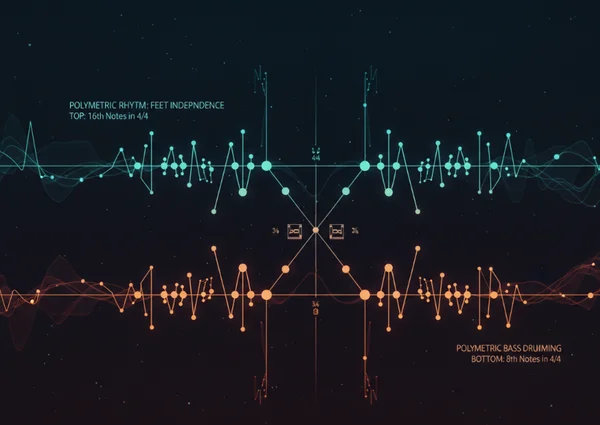
Most metal is in 4/4, but modern progressive styles often use odd time signatures like 5/8, 7/8, or 12/8. Practicing double bass in these signatures is essential for versatility. It forces your "lead foot" to switch or requires you to think in different groupings of notes.
Our customizable practice metronome allows you to customize time signatures easily. Try playing a steady 16th note pattern with your feet while the metronome clicks in 7/8. This creates a "shifting" feel that will significantly improve your rhythmic independence and mental focus.
Single vs. Double Stroke Rolls: Building Versatile Footwork
While most double bass is played with single strokes (RLRL), some drummers use double strokes (RRLL) to achieve extreme speeds. This requires a "swivel" or "heel-toe" technique. Training these rudiments with a metronome is the only way to ensure the doubles are even.
If your second stroke is quieter or slower than the first, the rhythm will sound "galloped" rather than smooth. Use the subdivision feature to ensure that the "LL" part of the stroke is just as crisp as the "RR" part. Mastering both single and double strokes makes you a much more versatile drummer.
Your Journey to Double Bass Excellence Starts Today
Think of double bass mastery like building endurance for a race—consistent pacing trumps short bursts. It requires patience, physical awareness, and, most importantly, the right tools. By understanding the science of muscle memory and following a progressive training system, you can break through the plateaus that hold many drummers back.
Remember that speed is a byproduct of accuracy. If you focus on being perfectly in time at 80 BPM, the transition to 160 BPM will happen much more naturally. Don't let frustration stop your progress. Use the features like tap tempo, subdivisions, and custom BPM settings to tailor your practice to your needs.

Grab your sticks and sync your feet—set up today's session with our free online metronome tool. Set your BPM, choose your subdivision, and start building the precision timing that every great drummer needs.
Frequently Asked Questions About Double Bass Drum Training
How often should I practice double bass with a metronome to see results?
For noticeable improvement, consistency is more important than duration. Practicing for 20 to 30 minutes every day is much better than a single five-hour session once a week. Daily practice keeps the neurological pathways fresh and prevents muscle stiffness. You should see significant gains in control within three to four weeks of daily metronome use.
What's the fastest tempo I should aim for with double bass drumming?
There is no "maximum" speed, as the genre often dictates the tempo. However, a professional standard for many metal subgenres is the ability to play clean 16th notes at 180 to 200 BPM. That said, don't chase a number. Aim for the speed that allows you to play the music you love with perfect clarity. Use our precision clicking interface to track your personal bests as you improve.
Can I use a metronome for double bass if I have smaller feet?
Absolutely. Foot size does not dictate your ability to play double bass. While some techniques like the "heel-toe" might feel different depending on the size of your pedal and foot, the fundamental rhythm and timing remain the same. The metronome is a tool for your brain and muscles, regardless of your physical stature. Focus on the "click" and finding a pedal adjustment that feels comfortable for your frame.
How do I prevent ankle fatigue during extended double bass practice?
Fatigue is usually caused by tension. When drummers try to play faster than they are ready for, they "grip" their muscles, which restricts blood flow. To prevent this, always start your session with a 5-minute warm-up at a slow tempo. If you feel a burning sensation or sharp pain, stop immediately and stretch. Use a digital rhythm guide to gradually build your endurance over months rather than trying to force it in a single day.
What's the difference between heel-down and heel-up techniques for double bass?
Heel-down involves keeping your entire foot on the pedal board, using primarily your shin muscles. It is great for low-volume, high-precision work but lacks power. Heel-up involves lifting your heel slightly, using your larger leg muscles (quadriceps and calves) to drive the pedal. Most metal drummers use a variation of heel-up for more power and speed. Regardless of your choice, the metronome will help you keep the strokes even and consistent.