World Rhythms Metronome Guide: Master African & Balkan Beats Online
Feeling the pulse of a West African djembe circle or the intricate dance of a Balkan wedding band can seem like an impossible challenge for musicians trained in standard 4/4 time. The complex layers and asymmetrical beats are thrilling but can be difficult to internalize. What if you could turn that complexity into clarity? This guide shows you how to use a metronome online to deconstruct, practice, and master these beautiful world rhythms, all without downloads or subscriptions. With our completely free online metronome, you have the perfect tool to begin your journey.
Understanding African Polyrhythms with an Online Metronome
African rhythm is built on the conversation between multiple patterns playing simultaneously, creating a rich, hypnotic tapestry of sound. The key isn't just counting; it's about feeling how different rhythmic lines interlock. This is where a customizable online metronome becomes your most valuable practice partner.
Breaking Down the 3:2 Cross-Rhythm
The 3:2 polyrhythm, or hemiola, is a foundational element in much of Sub-Saharan African music. It's the sound of three beats played in the same time it takes to play two. Here’s how to start internalizing it:
-
Set Your Foundation: Navigate to our time signature metronome and select a 6/8 time signature. Set the tempo to a slow 60 BPM.
-
Activate Subdivisions: Turn on eighth-note subdivisions. You will hear six clicks per measure.
-
Practice the "Two" Side: With your left hand, tap on beats 1 and 4. This represents the "two" side of the rhythm, falling on the main pulses.
-
Practice the "Three" Side: With your right hand, tap on beats 1, 3, and 5. This is the "three" side of the rhythm, creating a triplet feel against the main pulse.
-
Combine and Listen: Start by playing the parts separately, then slowly combine them. The visual beat indicator on our metronome will help you see exactly where each hand should land.
Using Visual Cues and Sound to Master Patterns
For patterns like the Guinean kuku or Ghanaian adowa, precision is everything. Our metronome offers more than just an audible click. Use our visualizer to see the beat, and assign different sounds to the main beat versus the subdivisions. For example, set the main beat to a "cowbell" and subdivisions to a "woodblock." This audio separation helps your brain process the different rhythmic layers more easily. As you get comfortable, use our tap tempo feature to match the tempo of a recording you're learning from, ensuring your practice is authentic.
"African rhythms live in the spaces between beats. Your metronome shouldn't restrict—it should reveal those spaces." - Sékou Diabaté, Mali Percussionist
Mastering Balkan Odd Time Signatures with Our Free Metronome
Balkan music is famous for its "limping" or asymmetrical meters, often called aksak rhythms. These odd time signatures, like 7/8 or 9/8, give the music its unique, energetic drive. While they might seem intimidating, they are simply combinations of two- and three-beat groups.
Deconstructing 7/8 and 9/8 Time Signatures
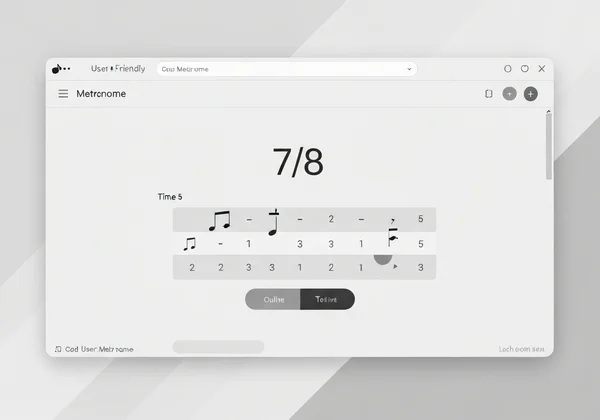
A common Bulgarian rachenitsa in 7/8 is structured as 2+2+3, giving it a quick-quick-slow feel. Here’s a practical approach using our tool:
- Go to the metronome and set a custom 7/8 time signature.
- Use the accent feature to place a strong accent on beat 1 and secondary accents on beats 3 and 5 (the start of each beat group).
- Start at a very slow tempo, around 70 BPM, and clap the rhythm. Verbally say "ONE-two, ONE-two, ONE-two-three" along with the metronome.
- Once you're comfortable, try playing the rhythm on your instrument. The color-coded beat display helps you anticipate the longer three-beat phrase.
For a 9/8 rhythm, the common division is 2+2+2+3. You can use the same accenting technique to feel the four distinct beat groups within the measure.
Capturing the Feel of Live Folk Dances
Traditional folk music is rarely played at a perfectly static tempo. It breathes, speeds up, and slows down with the energy of the dancers. This is where a simple click track fails. To practice authentically, find a recording of a Bulgarian kopanitsa and use our tap tempo function by clicking your mouse or tapping your spacebar along with the music. Our tool will instantly calculate the BPM, allowing you to practice at a tempo that reflects the live, human element of the music.
Pro Settings on Your Metronome Online for Cultural Authenticity
Mastering world rhythms requires more than just correct notes and timing; it involves capturing the right feel and timbre. A flexible online metronome allows you to fine-tune your settings for a more immersive and culturally resonant practice session.
Adjusting Tempo and Subdivisions for Regional Styles
The tempo and rhythmic feel can vary dramatically from one region to another. A generic metronome setting won't suffice.
- West African Highlife: Often features a relaxed groove around 90-120 BPM with a swing-style sixteenth-note subdivision.
- Bulgarian Horo: Can range from a slow 72 BPM to a blistering 144 BPM, depending on the specific dance.
- Turkish Usul Cycles: These complex rhythmic modes often require intricate subdivisions. A 9/8 aksak might be subdivided into sixteenth notes to capture the delicate ornamentation.
Use our versatile online metronome to save presets for different styles, like "Mali Djembe Circle - 110 BPM" or "Bulgarian Rachenitsa - 130 BPM," for instant recall during your practice sessions.
Choosing Sounds for Better Rhythmic Immersion
The sterile "beep" or "click" of a standard digital metronome can feel disconnected from the organic sounds of world percussion. The sound you practice with matters. Switching the metronome sound can fundamentally change how you feel the beat.
- Use a woodblock sound for West African drumming practice to better blend with the tones of a djembe or dundun.
- Select a frame drum sample with distinct dum (low) and tek (high) sounds to practice Balkan or Middle Eastern rhythms.
- Experiment with different accent sounds to mimic the tonal variations of the traditional instruments.
Explore our free sound library to find the tones that make the rhythm feel less like a mathematical exercise and more like music.
Your Path to Global Rhythm Mastery Is Here
The borders of music dissolve when you have the right tools to navigate them. By transforming a complex rhythm into manageable components, you can move beyond imitation and truly internalize the grooves of different cultures. Our ad-free tool is designed to provide the precision and flexibility you need, whether you are dissecting Senegalese sabar drumming or locking into a Serbian kolo dance.
Don't let complex time signatures hold you back. The journey to rhythmic fluency begins with a single, perfectly placed beat. Open your browser and start practicing on MetronomeOnline.org today. It's completely free, requires no installation, and is ready to guide your next practice session.
Frequently Asked Questions About World Rhythm Practice
What is a good starting tempo for practicing African polyrhythms?
A slow tempo of 60-80 BPM is ideal. This pace allows your brain to process the interlocking parts without feeling rushed. Focus on accuracy and the feel of the groove first. As your muscle memory develops, you can gradually increase the speed. Use our free tempo metronome to save your starting and goal tempos for each session.
How do I stop my playing in odd meters from sounding stiff and robotic?
This is a common challenge. Try using our metronome's silent bar feature to play one measure with the click and the next without it. This forces you to internalize the pulse rather than just relying on the click. Also, listen to many native players to absorb the natural rhythmic phrasing and lilt, which is often impossible to notate perfectly.
Are there specific cultural considerations to keep in mind?
Yes, absolutely. Rhythm is often deeply tied to cultural context, be it ceremonial, social, or historical. Beyond technical practice, take time to research the origins of the rhythms you are learning. Understand their function and meaning. Whenever possible, learn from artists from that culture, as they can provide insights that go far beyond what a metronome can teach.