Polyrhythm Mastery: Advanced Rhythm Training with Metronome Online
Have you ever listened to a piece of music that felt like it had multiple heartbeats at once? This mesmerizing effect, often found in jazz, progressive rock, and world music, is likely the magic of polyrhythms. For many musicians, mastering these complex rhythmic layers seems like a monumental task. How can you practice playing two or more different rhythms at the same time without getting lost?
The secret isn't just about talent; it's about having the right tools and a clear method. This guide will demystify polyrhythms, breaking them down into simple, understandable concepts. More importantly, we will show you how to use a powerful, free metronome tool to practice and conquer them. With the right approach, you can transform your rhythmic vocabulary and add incredible depth to your music. To get started, you can immediately access a professional-grade tool right on our homepage—try our free tool and follow along.
What Are Polyrhythms and Cross-Rhythms?
Before we dive into practice, let's clarify what we're dealing with. Polyrhythms are a fundamental concept in music that can sound complex but are based on simple mathematical relationships. Understanding them is the first step toward playing them with confidence.
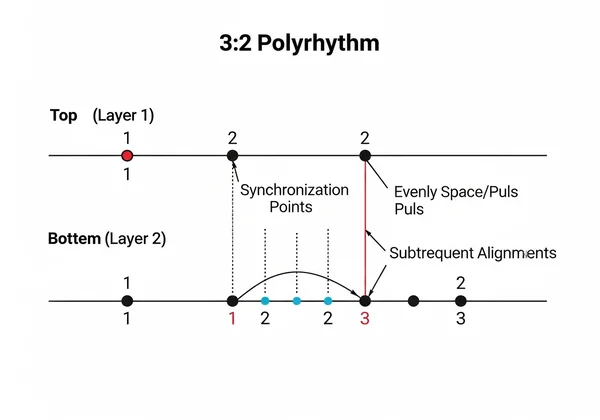
A polyrhythm occurs when two or more independent rhythms are played simultaneously. The most common example is playing three notes evenly over the same duration that two notes are played. This is called a "3 against 2" or 3:2 polyrhythm. The tension and release created by these overlapping patterns are what make them so compelling to the ear.
Understanding the Mathematics of Complex Rhythms
At its core, a polyrhythm is a ratio. A 3:2 polyrhythm means one part plays three equal beats while another part plays two equal beats in the same amount of time. To find the common pulse, you find the least common multiple. For 3:2, the rhythms align on every sixth subdivision.
Think of it like this:
- Rhythm 1 (2 beats): 1 & 2 &
- Rhythm 2 (3 beats): 1 & a 2 & a
When played together, the combined pattern feels intricate. The key to practicing them is to first internalize the sound of the combined rhythm before attempting to separate the parts. Using a flexible tool like an online metronome app that allows for detailed subdivisions is essential for hearing and practicing these mathematical relationships accurately.
Common Polyrhythms in World Music and Jazz
Polyrhythms are not just a theoretical exercise; they are the lifeblood of many musical genres. West African drumming, for example, is famous for its rich, polyrhythmic textures. Different drummers layer distinct patterns to create a complex but unified groove.
In jazz, musicians often use polyrhythms to create rhythmic tension during improvisation. A pianist might play a 3:2 pattern with their right hand over a standard 4/4 comping pattern with their left. Similarly, drummers in progressive rock and metal frequently use cross-rhythms—a related concept where the accent pattern shifts against the main beat—to create powerful and disorienting effects. Listening to these genres is a great way to train your ear to recognize these fascinating patterns in the wild.
Setting Up Your Metronome for Polyrhythm Practice
A basic metronome that only clicks on the beat is not enough for polyrhythm practice. You need a tool that gives you control over the subdivisions—the smaller notes between the main beats. This is where MetronomeOnline.org excels, offering features designed for advanced rhythmic training.
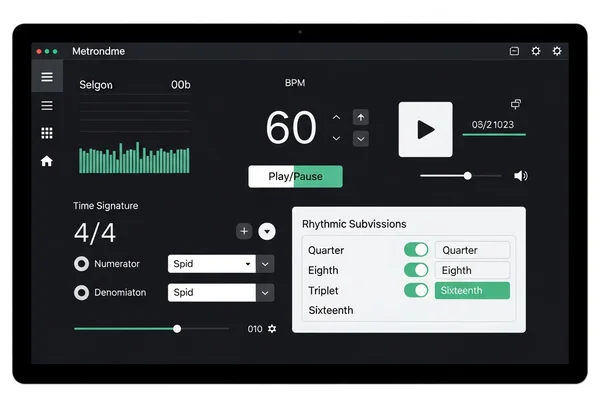
Our free online tool allows you to set not only the BPM and time signature but also the rhythmic subdivisions. This feature is your key to unlocking polyrhythm exercises. Configure the metronome to play both rhythms simultaneously. This trains your ear and body to feel the complete groove before you even touch your instrument.
Customizing Subdivisions for Complex Time Signatures
To practice a 3:2 polyrhythm, you need to hear both the two-beat pulse and the three-beat pulse. On MetronomeOnline.org, you can set the metronome to play triplets (three notes per beat) against a standard quarter-note pulse.
Here’s a simple setup for a 3:2 polyrhythm in 4/4 time:
- Go to the metronome tool.
- Set the main beat to a slow tempo, like 60 BPM.
- Choose a subdivision that accents the triplet feel.
- Tap the two-beat rhythm with one hand (e.g., on beats 1 and 3).
- Simultaneously, tap the three-beat rhythm with your other hand, fitting three even notes over every two main beats.
This setup gives you a clear audio guide for the entire pattern, making it much easier to internalize the feel.
Utilizing Silent Beats to Create Polyrhythmic Patterns
Another powerful feature for advanced practice is using silent beats. As you become more comfortable, you can challenge your internal clock by having the metronome play only certain parts of the rhythm. For instance, you could set the metronome to play only the "2" side of a 3:2 polyrhythm, forcing you to generate the "3" side on your own.
This technique is like taking the training wheels off. It tests your ability to maintain one rhythm while hearing another, which is crucial for developing true rhythmic independence. This advanced feature, available on our rhythm practice tool, helps you transition from simply copying a pattern to truly owning it.
Progressive Polyrhythm Exercises for All Skill Levels
Here's the secret to mastering these complex rhythms: start simple and build gradually. No matter your instrument or current skill level, you can begin practicing polyrhythms today. The key is to start slow and focus on accuracy over speed.
We’ve designed a series of progressive exercises that you can do with our online metronome. For each exercise, set a comfortable tempo (60-80 BPM is a great start) and focus on keeping your timing perfectly even.
Beginner-Friendly 3:2 Polyrhythm Patterns
The 3:2 polyrhythm is the gateway to this rhythmic universe. It's the most common and the easiest to feel.
- Listen First: Set up the metronome to play both parts. Just listen for a few minutes.
- Clap the Pattern: Use your right hand to clap the "2" pulse and your left hand to clap the "3" pulse. A helpful mnemonic phrase is "Not difficult." Say it evenly over two beats, and your hands will naturally perform a 3:2 polyrhythm.
- Apply to Your Instrument: Once you can clap it, try playing it. Pianists can play the 2-beat part with their left hand and the 3-beat part with their right on a single note. Guitarists can tap the parts on the body of the guitar.
Intermediate 4:3 and 5:4 Cross-Rhythm Challenges
Once 3:2 feels natural, you’re ready for a greater challenge. The 4:3 polyrhythm is common in jazz and fusion music. A helpful mnemonic for 4:3 is "Pass the god-damn butter," spoken evenly over a single beat.
For these more complex patterns, using the subdivision feature on the MetronomeOnline.org tool is critical. You'll need to divide the beat into 12 parts (the least common multiple of 3 and 4) to hear exactly where each note falls. Start by clapping, then move to your instrument, always prioritizing precision. The 5:4 polyrhythm is even more advanced and is often found in contemporary classical and progressive metal music.
Advanced Polyrhythms for Progressive and Classical Music
For the truly adventurous, exploring polyrhythms like 7:4 or complex layered patterns opens up a new world of expressive possibilities. Composers like Igor Stravinsky and bands like Tool have famously used these advanced rhythms to create powerful, mind-bending music.
Practicing these requires immense focus and a reliable, highly customizable metronome. You can set up custom beat patterns and subdivisions on our platform to build these rhythms from the ground up. Start by looping just one bar, and only increase the tempo when you can play it perfectly ten times in a row.
Real-World Applications of Polyrhythm Techniques
Learning polyrhythms isn't just a mental workout; it has practical benefits that will elevate your playing in any genre. Developing rhythmic independence allows you to play with more creativity, groove, and confidence.
Internalizing complex rhythms makes you a better listener and a more adaptable musician in group settings. When the drummer lays down a complex groove, you'll be able to lock in with them instead of getting lost. It enhances your improvisational skills and deepens your understanding of musical structure.
Applying Polyrhythms in Jazz Improvisation
Jazz musicians often use a classic technique: superimposing a three-beat phrase over a 4/4 swing feel. This creates tension in solos. A soloist might play a melodic pattern in groups of three eighth notes, which creates a rhythmic dissonance against the underlying four-beat meter. After a few bars, they resolve the pattern back to the main pulse, creating a satisfying release for the listener. Using a tap tempo feature can help you identify these patterns when listening to your favorite players.
Polyrhythmic Patterns in Rock and Metal Drumming
Modern rock and metal drumming are filled with polyrhythmic ideas. A drummer might play a steady 4/4 on their hi-hat and snare while playing a kick drum pattern in groups of three or five sixteenth notes. This creates a dense, powerful groove that feels both stable and chaotic at the same time. Drummers can use our online metronome's subdivision and accent features to isolate and practice these limb-independent patterns.
Transform Your Rhythmic Vocabulary Today
Polyrhythms may seem intimidating, but they are an accessible and rewarding skill for any musician to develop. Break polyrhythms down into their mathematical components. Practice them systematically to unlock new levels of rhythmic expression and musical freedom.
As you work through these polyrhythms, remember these essential points:
- Start with the basics: Master the 3:2 polyrhythm before moving on to more complex ratios.
- Use the right tool: A customizable metronome with subdivision controls is essential for effective practice.
- Practice slowly and consistently: Accuracy is more important than speed. Build a solid foundation first.
Don't let complex rhythms hold you back any longer. The ability to understand and execute polyrhythms will fundamentally change how you hear, feel, and play music. Ready to begin your journey to rhythmic mastery?
Visit MetronomeOnline.org now, set up your first exercise, and start transforming your rhythmic vocabulary today.
FAQ Section
What is the best BPM to start practicing polyrhythms?
It's always best to start very slow, typically between 50 and 70 BPM. This allows your brain to process the complex relationship between the rhythms without feeling rushed. Focus on perfect execution at a slow tempo before gradually increasing the speed.
How long does it typically take to master polyrhythms?
Mastery varies greatly from person to person. It depends on your prior musical experience and practice consistency. You can feel comfortable with a 3:2 polyrhythm within a few weeks of dedicated practice, while more complex ratios like 5:4 or 7:4 can take months or even years to fully internalize and apply musically.
Can I practice polyrhythms on any instrument with this metronome?
Yes, absolutely. Polyrhythm is a universal musical concept. Whether you play piano, guitar, drums, bass, or a wind instrument, the exercises can be adapted. Our free metronome app works for any musician looking to improve their rhythmic skills, regardless of their instrument.
What's the difference between a polyrhythm and a cross-rhythm?
The terms are often used interchangeably, but there's a subtle difference. A polyrhythm is the simultaneous use of two or more conflicting rhythms. A cross-rhythm is a specific type of polyrhythm where the rhythmic emphasis or accent pattern conflicts with the main meter (e.g., accenting every third sixteenth note in a 4/4 bar).
Are there famous songs that use polyrhythms I should listen to?
Definitely! For a classic 3:2 feel, listen to the first movement of Beethoven's "Moonlight Sonata." For a rock example, the main riff of "Kashmir" by Led Zeppelin has a 4/4 drum beat against a 3/4 guitar riff. In jazz, Mongo Santamaria's "Afro Blue" is a beautiful example built on a 6/8 vs. 3/4 polyrhythm. The band Tool is also famous for using them, as in the song "Lateralus."