Master Silent Metronome Practice: Train Your Internal Rhythm
Every musician knows the feeling. You're locked in with the metronome, every note perfectly aligned with the click. But what happens when the click stops? For many, the timing falters. This reliance on an external beat can hold back your true musical potential, preventing you from developing a deep, unshakable internal rhythm.
Imagine playing confidently without relying on the click—this guide shows you how. It’s a method used by professional musicians to transform their timing from dependent to self-sufficient. We’ll show you how to move beyond the click and build an internal clock that you can trust in any musical situation. With a versatile and precise tool like our free online metronome, you have everything you need to begin this transformative journey today.

Why Your Internal Rhythm Needs Muted Beat Exercises
Before diving into the "how," it's crucial to understand "why" this practice is so effective. Muted beat exercises, a core component of silent metronome practice, are designed to challenge your brain and push you beyond passive listening. This method actively develops your innate sense of time.
Breaking Free from the Click: The Dangers of Over-Reliance
A metronome is essential but can become a crutch. With a constant audible click, your brain outsources timekeeping. You react to the sound instead of creating your own pulse.
This over-reliance becomes obvious during performances, ensemble playing, or moments of improvisation where there is no click to guide you. You might rush, drag, or feel rhythmically insecure. Silent practice breaks this dependency by forcing you to be responsible for the beats the metronome doesn't play.
The Neuroscience Behind Auditory Discipline and Tempo Retention
Practicing with silent beats is a powerful form of brain training. Our brains are excellent at predicting patterns. When you hear a steady rhythm, your brain anticipates the next beat. A muted beat exercise intentionally creates gaps in that pattern.
To fill these silent gaps accurately, your brain has to work harder. It must maintain the tempo internally without an external cue. This strengthens neural pathways for time perception and motor control. In short: auditory discipline means holding the tempo in your mind. Over time, this improves your tempo retention, allowing you to hold a steady pulse for long periods.

Key Benefits: Enhanced Performance, Confidence, and Musicality
Integrating muted beat exercises into your routine offers tangible rewards that will elevate your playing, regardless of your instrument or skill level.
- Rock-Solid Timing: Your ability to keep time becomes internalized, making you a more reliable and sought-after musician in any band or ensemble.
- Increased Confidence: You'll walk onto any stage or into any session knowing your rhythm is solid, freeing you to focus on expression and creativity.
- Deeper Musicality: When you no longer have to consciously think about keeping time, your playing becomes more fluid and expressive. You can feel the groove instead of just following a click.
- Improved Improvisation: A strong internal clock is the foundation for creative freedom, allowing you to explore complex rhythms without getting lost.
How to Set Up Silent Practice (Using Our Online Tool)
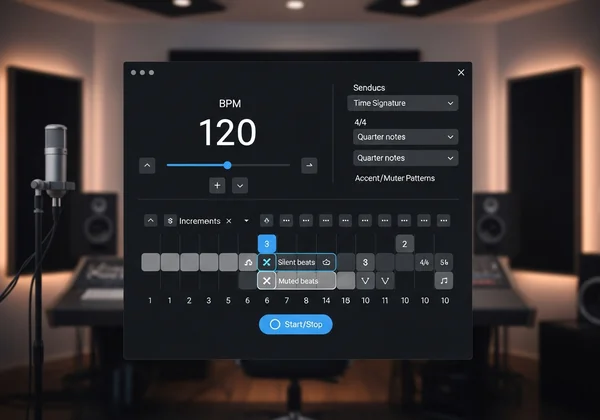
The key to successful silent practice is a tool that offers precision and flexibility. The customizable metronome is perfectly designed for this, giving you full control over every aspect of the beat. Here’s how to set it up.
Customizing Beat Subdivisions for Strategic Silence
One of the most effective ways to create "silent" beats is by using subdivisions. Subdivisions are the smaller rhythmic units within a main beat (like eighth or sixteenth notes).
For example, to practice feeling the quarter note pulse, you can set the metronome to play sixteenth notes but only play the first sixteenth note of each beat. Your brain hears the "one" of each beat, and you become responsible for feeling the rest of the silent subdivisions. This method builds a highly accurate sense of rhythmic placement.
Utilizing Accent Features for Conscious Beat Omission
A more direct way to create silence is by controlling which beats are heard within a measure. Our online tool allows you to set the number of beats per measure (from 1 to 12) and add or remove accents.
To start, set the time signature to 4/4. By default, beat one is often accented. You can use this feature to mute other beats. For instance, you can set the metronome to only click on beats 1 and 3. This forces you to generate beats 2 and 4 on your own, a fundamental exercise for developing a sense of half-time and backbeats.
Finding Your Optimal Starting Tempo for Internalization
When you first start with muted beat exercises, the goal is not speed; it's accuracy. Rushing into a fast tempo will only lead to frustration.
Begin at a slow, comfortable tempo where you can clearly feel the space between the clicks—somewhere between 60 and 80 BPM is often a great starting point. At this speed, you give your brain enough time to process the silence and actively engage in timekeeping. As you become more comfortable, you can gradually increase the tempo.
Progressive Exercises for Advanced Tempo Retention
Once you're comfortable with the basic setup, you can begin a structured routine. These progressive exercises are designed to systematically build your internal clock from the ground up.

Level 1: Muting Every Other Beat (Half-Note Focus)
This is the perfect starting point for your internal rhythm training.
- Open our online metronome tool.
- Set the time signature to 4/4 and the tempo to a slow 70 BPM.
- Set the metronome to only play on beats 1 and 3.
- Play a simple scale or a single note, making sure you accurately place the notes that fall on the silent beats (2 and 4).
- Focus on feeling the pulse continue through the silence. Tap your foot if it helps.
Level 2: Introducing Silent Measures (Ghost Bar Training)
This exercise takes the challenge to the next level by introducing entire bars of silence.
- Keep the tempo slow (around 60-70 BPM).
- Set the metronome to play one full bar of 4/4 clicks, followed by one full bar of silence. (You can simulate this by counting one bar on, one bar off).
- Your goal is to continue playing through the silent bar and land perfectly on beat 1 when the click returns.
- This exercise is a true test of your tempo retention.
Level 3: Advanced Rhythmic Gaps and Syncopated Silence
For those ready for a serious challenge, try creating less predictable patterns of silence.
- Set the metronome to 4/4.
- Have it click only on beat 2 and the "and" of beat 4.
- This forces you to internalize the downbeat (beat 1) without hearing it, a skill essential for understanding syncopation and groove.
- Experiment with other patterns, like only clicking on beat 4, to push your internal clock to its limits.
Integrating Silent Practice into Ensemble and Solo Performance
These exercises prepare you for real music. Start using silent patterns in songs, solos, or grooves today. If you're a guitarist, practice a riff with only beats 2 and 4 clicking. If you're a drummer, practice a groove with a full bar of silence. This will directly prepare you for the dynamic nature of live performance.
Maximizing Your Internal Clock Training
To get the most out of your silent metronome work, incorporate these habits into your routine.
The Role of Active Listening and Mental Counting
Silent practice is as much a listening exercise as it is a playing exercise. When the metronome is silent, don't let your mind wander. Stay engaged by counting the silent beats out loud ("1, 2, 3, 4") or in your head. This active mental engagement is what builds the strong neural connections needed for a reliable internal rhythm.
Tracking Progress: Recording and Self-Assessment
How do you know if you're really improving? The answer is simple: record yourself. Use your phone or any recording device to capture your practice sessions, especially the "ghost bar" exercises.
Listen back and be honest. Did you speed up or slow down during the silent bar? Did you land precisely on beat 1 when the click came back? This feedback is priceless. It shows you exactly where you need to focus your attention and provides clear evidence of your progress over time.
Consistency is Key: Integrating Daily Muted Beat Drills
Developing a world-class internal clock doesn't happen overnight. It's the result of consistent, focused effort. Even just 10-15 minutes of dedicated silent metronome practice each day will yield far greater results than one long session per week.
Make it a non-negotiable part of your warm-up routine. This consistency will solidify your sense of time until it becomes second nature. Ready to start your practice?
Unlock Your True Rhythmic Potential
Unlocking your true rhythm begins when the metronome goes silent. It’s the transition from following the beat to being the beat. By embracing silent metronome practice, you are not just improving your timing; you are fundamentally deepening your relationship with music. You are building confidence, enhancing your musicality, and developing an unshakeable internal rhythm that will serve you in every note you play.
The exercises in this guide provide a clear roadmap. With a powerful and flexible tool like our customizable metronome, you have everything you need to start training your internal clock today.
Ready to break free from the click and become the master of your own time? Begin your first muted beat exercise now.
Frequently Asked Questions About Internal Rhythm Training
Here are answers to common questions about silent metronome practice:
What is a good tempo for internal rhythm practice?
A slow tempo, typically between 60-80 BPM, is ideal when starting out. This provides enough mental space to feel the pulse during the silent gaps. As you become more confident, you can gradually increase the speed.
How do you effectively train your internal clock for rhythm?
Effective training involves three key elements: consistency (daily practice), progressive challenge (moving from simple to complex silent patterns), and self-assessment (recording yourself). Using a versatile rhythm practice tool to create these patterns is crucial.
Can a silent metronome really improve my playing?
Absolutely. It forces you to internalize the beat rather than just react to it. This leads to more confident and expressive playing, better ensemble cohesion, and a stronger ability to groove and improvise.
How is "auditory discipline" related to metronome practice?
Auditory discipline is the mental skill of maintaining a steady tempo without an external sound source. Silent metronome practice is the primary method for developing this skill by creating intentional auditory gaps that your brain must learn to fill in accurately.
What are some common pitfalls when starting muted beat exercises?
The most common mistakes are starting at a tempo that is too fast, trying overly complex silent patterns too soon, and failing to record and listen back for honest feedback. Be patient, start simple, and always use recording as your guide.