Ideal Free Online Metronome Speeds: Best Practice BPMs for Scales & Songs
Welcome, musician! You’ve picked up your instrument, you're ready to practice, but one big question stops you in your tracks: How fast should I set the metronome? Setting the tempo too high leads to frustration and sloppy playing. Setting it too low can feel unproductive. Finding that "just right" speed is the key to unlocking consistent progress.
This guide is here to solve that exact problem. We will walk you through the ideal metronome speeds for different skill levels and practice goals, from mastering scales to learning your favorite songs. Think of this as your roadmap to building a rock-solid sense of rhythm and flawless technique.
The right tempo is your greatest practice partner, and having a reliable tool is essential. At our site, we provide a powerful, free, and easy-to-use online metronome that is perfect for every exercise in this guide. Let's find your perfect practice BPM and start building your musical mastery.
What is a Good Tempo for Practice? Finding Your Baseline BPM
Before we talk numbers, we need to understand the core principle of effective practice. The best tempo isn't a magic number—it's the speed at which you can play a piece of music or an exercise perfectly, without mistakes. This is your baseline BPM, and it’s the foundation for all future progress.
The Golden Rule: Start Slow, Build Gradually for Mastery
Every great musician lives by a simple rule: start slow. It might feel counterintuitive, but practicing slowly is the fastest way to learn to play fast. When you play slowly, you give your brain and muscles time to build accurate memory. Every note is clean, every movement is precise, and every rhythm is perfectly in time.
Rushing through a passage with a fast tempo only trains you to play with mistakes. Instead, find a speed where you can perform the exercise flawlessly. Once you can play it perfectly multiple times in a row, you've earned the right to increase the speed slightly, perhaps by 2-4 BPM. This gradual process ensures you build a solid foundation of accuracy that holds up even at high speeds.
Assessing Your Current Skill Level: Beginner, Intermediate, or Advanced?
Your ideal starting tempo depends heavily on your current ability. Be honest with yourself about where you are on your musical journey. This self-assessment will help you set realistic and effective practice goals.
- Beginner: If you are new to your instrument or a specific technique, your focus should be on clarity and control. Your fingers are still learning the movements. A slow tempo is not just a suggestion; it's a requirement for building good habits.
- Intermediate: You have a solid grasp of the basics and can play some pieces comfortably. Your goal is to increase dexterity, consistency, and speed. You can start at a more moderate tempo but should still follow the rule of starting slow for any new or challenging material.
- Advanced: You have excellent technical control and can play complex music. Your practice might focus on pushing the upper limits of your speed, refining intricate passages, or mastering subtle rhythmic nuances. Even at this level, slowing things down is a powerful tool for polishing and perfecting.
BPM for Scales Practice: Accelerating Your Instrumental Technique
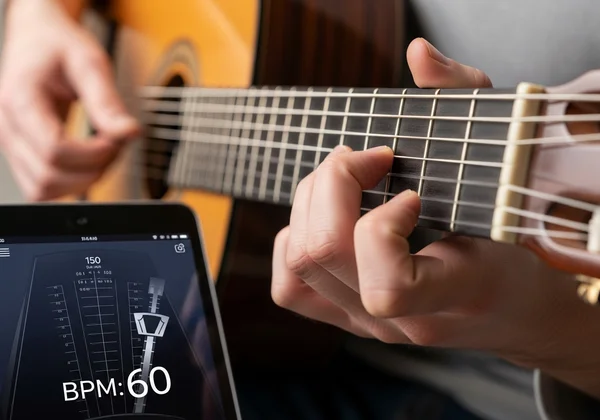
Scales are the building blocks of music. Practicing them with a metronome is one of the most effective ways to improve your speed, accuracy, and overall command of your instrument. Here’s how to approach setting your BPM for scales.
From Crawl to Run: Beginner's Metronome Settings for Scales (e.g., 60-80 BPM)
For beginners, the goal is not speed but perfection. Start in the 60-80 BPM range, playing one note per click (quarter notes). At this speed, you have plenty of time to think about your fingering, posture, and the quality of your sound. Can you play the entire scale up and down without any mistakes, buzzes, or fumbles?
If 60 BPM feels too fast, don’t hesitate to go slower. The goal is 100% accuracy. Once you master the scale at one note per click, you can challenge yourself by playing two notes per click (eighth notes) at the same tempo. This simple change doubles your playing speed without making the click feel overwhelming. You can easily set your BPM and get started right away.
Mastering Dexterity: Intermediate & Advanced Arpeggios with Ideal BPMs (e.g., 90-140+ BPM)
For intermediate and advanced players, scales and arpeggios are about building serious speed and fluidity. Your starting tempo might be higher, perhaps in the 90-120 BPM range. Your goal is to push the boundaries of your comfort zone, but always with control.
A great exercise is to use a "tempo ladder." Start at a comfortable speed, say 100 BPM, and play a scale perfectly. Increase the tempo by 4 BPM and play it again. Continue this process until you reach a speed where your technique just begins to break down. Make a note of that tempo—it’s your current limit. In your next practice session, aim to push just past it. This systematic approach is how you build truly impressive speed over time.
Ideal Metronome BPMs for Songs: Bringing Music to Life
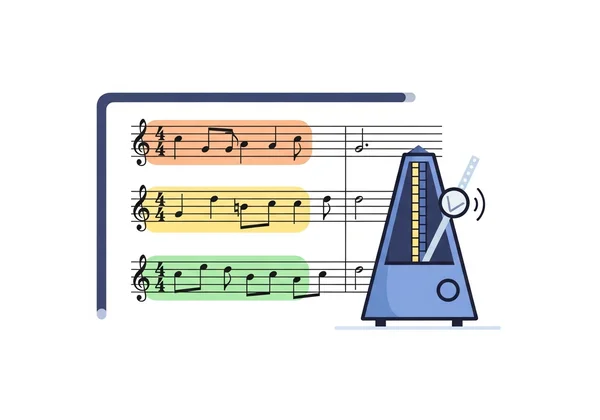
Practicing with a metronome isn’t just for technical exercises. It’s a crucial tool for learning to play songs with a steady, professional feel. Here’s how to apply these tempo strategies to actual music.
Deconstructing a Song: Practicing Sections at Slower Tempos
No one learns an entire song in one go. The most effective method is to break it down into smaller, manageable sections—like a single verse or a difficult guitar solo. Isolate a section first. Find a tempo where it's flawless. Expect it to be slower than the original.
By practicing one small part at a time at a slow, controlled tempo, you are programming the music into your muscle memory correctly. As you master each section, you can gradually increase the BPM. Eventually, you can string the sections together, confident that each part is solid and accurate.
Playing with the Band: Matching Original Song BPM & Performance Readiness
The ultimate goal is to play the song at its original tempo, as if you were playing with the band. Once you can play all sections of the song cleanly at slower speeds, it's time to work your way up to the performance BPM. You can find a song’s original tempo by searching online or by using a tool with a "Tap Tempo" feature.
Hit the final tempo to prep for gigs. It builds stamina and keeps you locked in tight. When you can play the song perfectly along with a metronome at its recorded speed, you know you’re ready for the stage, the studio, or your next jam session. Give our free metronome tool a try to find the perfect tempo.
Elevate Your Practice: Beyond Basic BPM with Online Metronome Features
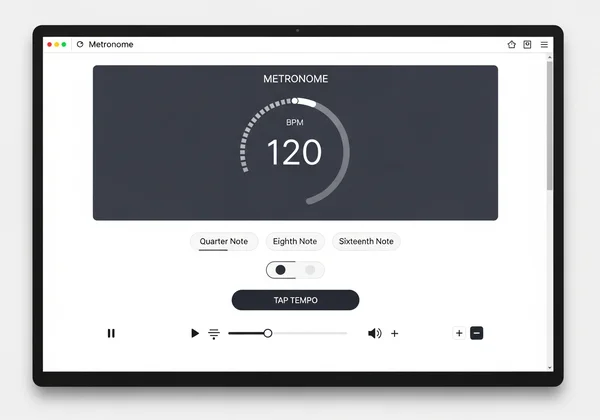
A great metronome does more than just click. Modern online tools offer features that can revolutionize your practice, helping you develop a deeper understanding of rhythm.
The Power of Subdivisions: Unlocking Complex Rhythms
Rhythm is more than just a steady beat. It's about how you divide that beat into smaller parts. Subdivisions like eighth notes (two notes per click), sixteenth notes (four notes per click), or triplets (three notes per click) are the key to playing complex and groovy rhythms.
Using a metronome that can accent or sound out these subdivisions is incredibly powerful. It tunes your internal clock to those smaller beats inside the pulse. Perfect for funk, jazz, or metal grooves. Our tool allows you to select different subdivisions, giving you a clear guide for practicing intricate rhythmic patterns.
Tap Tempo: Instantly Finding a Song's Rhythm or Your Internal Pulse
Have you ever heard a song and wondered, "What's the tempo of that?" Or maybe you have a rhythm in your head that you want to practice. The Tap Tempo feature is your solution. Simply tap a key or button in time with the music, and the tool will instantly calculate the BPM for you.
This feature is invaluable for learning songs by ear and for quickly setting up your practice session without having to guess the tempo. It connects the rhythm you feel internally with a precise, measurable number, making your practice more efficient and targeted.
Ready to Nail Your Rhythm?
Finding the right practice tempo isn't about chasing speed—it's about building the accuracy that makes speed possible. Stop the frustrating guesswork and lock in these habits to transform your playing:
- Always Start Slow: Why? It wires your brain for bulletproof accuracy. Speed will follow naturally.
- Be Systematic: Increase your tempo in small, steady steps, like climbing a ladder. Track your progress and own every win.
- Use the Right Tools: A great metronome with subdivisions and tap tempo isn't a crutch; it's a launchpad.
Your journey to perfect timing starts now. Grab our powerful, free online metronome, crank it to 60 BPM, and feel the difference. It's time to start practicing with purpose and build the confident, precise, and musical skills you've been aiming for.
Frequently Asked Questions About Practice BPMs & Metronomes
What is generally considered a good tempo for beginners to practice?
For absolute beginners, a tempo between 60 and 80 BPM is an excellent starting point. This range is slow enough to allow you to focus on correct fingerings, clean note production, and steady rhythm without feeling rushed. The most important thing is to choose a speed where you can play without making mistakes.
How can a metronome improve my playing beyond just keeping time?
A metronome does much more than keep time. It helps develop your internal clock, improves your rhythmic accuracy, and provides a clear benchmark for measuring progress in speed. Using features like subdivisions helps you understand and execute complex rhythms, while practicing with a metronome reveals any inconsistencies in your timing, allowing you to fix them.
How do I find the BPM of a song if I don't know it already?
The easiest way is to use a tool with a "Tap Tempo" feature. Simply listen to the song and tap along to the beat, and the tool will display the BPM. You can do this right now with our online metronome. Alternatively, many songs have their BPM listed on websites like Wikipedia or in music production forums.
Is it always necessary to practice with a metronome?
While it's also important to practice without a metronome to develop a natural, expressive sense of musical time, practicing with one is essential for building a solid rhythmic foundation. Think of it as a fundamental skill. It’s especially crucial when working on speed, learning new material, or preparing to play with other musicians. A healthy practice routine includes both metronome work and free playing.